Few subjects in contemporary Christianity generate as much confusion, division, and discomfort as speaking in tongues. For some, it is the definitive mark of Spirit-filled living. For others, it is a relic of the apostolic age, long ceased. For still others, it is a source of quiet unease, something witnessed in worship but never quite understood. What is often missing from these conversations is a careful return to Scripture itself, read in context, with attention to what the biblical writers actually describe and why.
The clearest account of tongues in the New Testament is found at Pentecost. In Acts 2, the disciples are filled with the Holy Spirit and begin to speak in other tongues. What follows is not ambiguity but specificity. Jews from across the known world, gathered in Jerusalem for the festival, hear the disciples declaring the wonders of God in their own native languages. The text lists the regions represented: Parthians, Medes, Elamites, residents of Mesopotamia, Judea, Cappadocia, Pontus, Asia, Phrygia, Pamphylia, Egypt, Libya, Rome, Crete, and Arabia. Each hears in their own dialect. The miracle is not mysterious noise but intelligible proclamation. The crowd is astonished precisely because they understand what is being said.
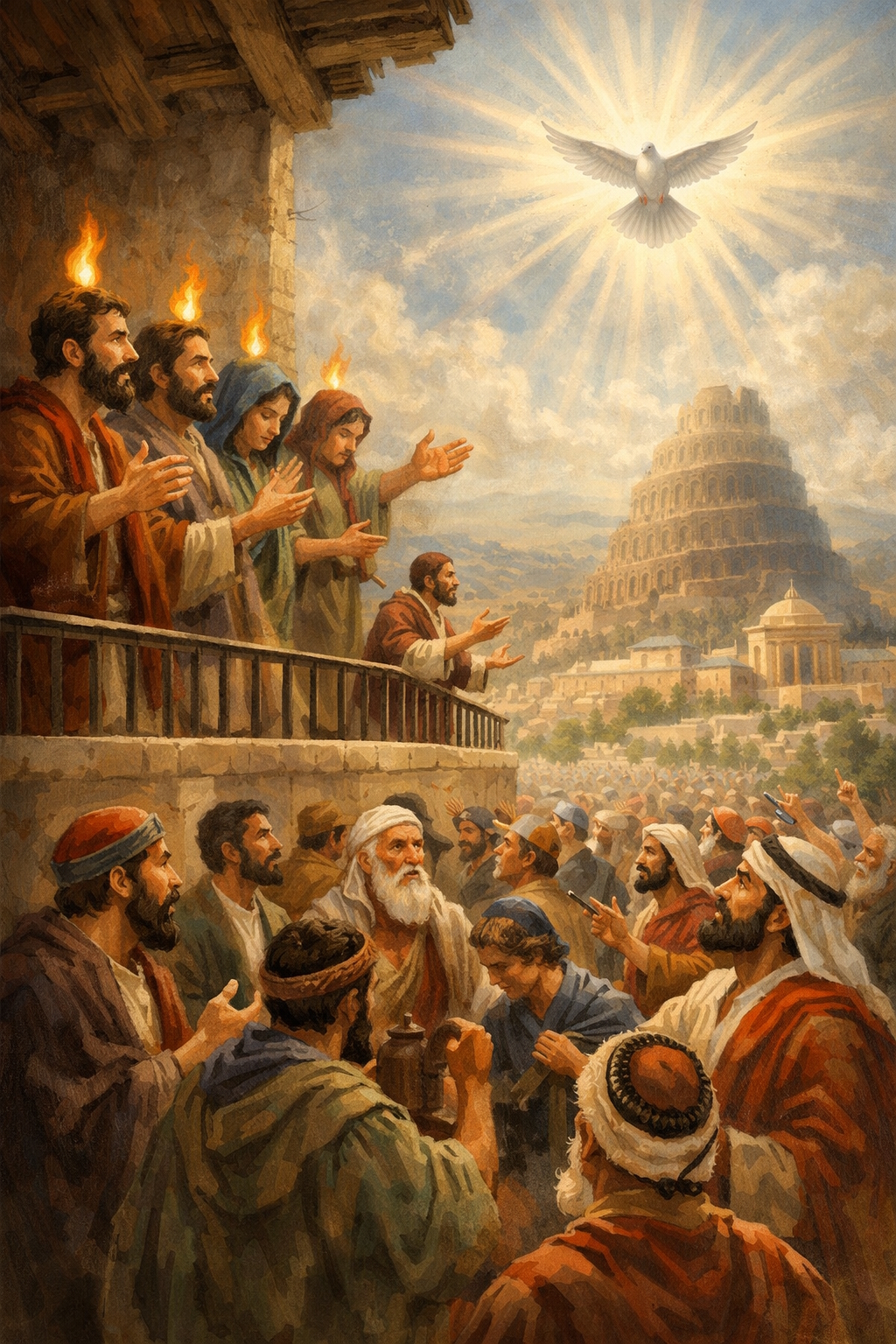
The early church recognised in this event a profound reversal. At Babel, recorded in Genesis 11, humanity had gathered in pride to build a tower reaching to heaven, united in rebellion against God’s command to fill the earth. God descended, confused their language, and scattered them across the face of the world. The single tongue became many, and the nations were divided. At Pentecost, the pattern is inverted. The Spirit descends, tongues of fire are distributed among the disciples, and the scattered nations hear the gospel in their own languages. Where Babel divided through judgement, Pentecost reunites through grace. Luke appears to signal this connection deliberately. The Greek word he uses for the crowd’s bewilderment in Acts 2:6, suncheo, is the same word the Septuagint uses for God confusing the languages at Babel. The verbal echo is unlikely to be accidental. What sin had fractured, the Spirit was beginning to restore.
This event sets the pattern for how tongues function throughout Acts. When the Spirit falls on Cornelius and his household, the Jewish believers recognise the phenomenon as the same sign given at Pentecost. When Paul encounters disciples in Ephesus who had received only John’s baptism, they speak in tongues and prophesy after receiving the Holy Spirit. In each case, the narrative assumes continuity with the Pentecost experience. Luke, the author of Acts, gives no indication that the nature of tongues has shifted from language to something else.
Paul’s extended discussion in 1 Corinthians 14 is often read as introducing a different kind of tongues, something ecstatic or non-linguistic. Yet a closer reading reveals the opposite. Paul quotes Isaiah 28:11-12, a passage in which God warns Israel that He will speak to them through foreign lips and strange tongues. The original context is the Assyrian invasion. God’s people had refused to listen to His prophets in their own language, so He would speak through the unintelligible speech of foreign conquerors as a sign of judgement. Paul applies this directly to tongues in the Corinthian church: they are a sign, not for believers, but for unbelievers. The logic only holds if tongues are actual languages. A non-linguistic utterance would not function as Isaiah’s foreign tongues did. Paul’s argument depends on semantic content.
This is reinforced by Paul’s insistence on interpretation. If there is no interpreter, the speaker should remain silent. The very concept of interpretation presupposes that there is something to interpret, that the speech carries meaning which can be rendered in another language. One does not interpret noise. One interprets language. Paul’s concern throughout the chapter is not that tongues are invalid, but that they are useless to the congregation without understanding. He would rather speak five words with his mind, to instruct others, than ten thousand words in a tongue. The contrast is between uninstructed speech and instructed speech, not between meaningful and meaningless sound.
The early church fathers understood tongues in precisely this way, and many explicitly connected Pentecost to the reversal of Babel. Irenaeus of Lyon, writing in the second century, spoke of believers who through the Spirit speak all kinds of languages and bring hidden things to light for the benefit of others. Gregory of Nazianzus, preaching on Pentecost in the fourth century, declared that though the old division of tongues at Babel was worthy of honour as God’s judgement on pride, this present miraculous division of tongues was even more worthy of praise, because it flowed from one Spirit out to many people, bringing them once more into one harmony. John Chrysostom, commenting on 1 Corinthians, explained that the apostles received tongues first because it was a sign that they were to go everywhere preaching the gospel. He noted that as in the time of building the tower the one tongue was divided into many, so at Pentecost the many tongues frequently met in one man. Augustine drew the same connection, arguing that pride had caused diversities of tongues at Babel, but Christ’s humility united these diversities into one, and that this was the doing of charity. None of these writers describe tongues as ecstatic utterance. All treat them as languages given for proclamation and mission, reversing what human rebellion had broken.
Modern linguistic research introduces a different consideration. Studies of contemporary glossolalia, the phenomenon observed in many Pentecostal and charismatic settings, consistently find that it does not possess the characteristics of language. William Samarin, a linguist who spent five years recording and analysing glossolalic speech across multiple countries and denominations, concluded that it is meaningless but phonologically structured human utterance, believed by the speaker to be a real language but bearing no systematic resemblance to any natural language, living or dead. He found that glossolalia lacks a lexicon, syntax, and morphology. It consists of syllables drawn from the speaker’s native language, arranged with repetition and rhythm, but without semantic content. It is, in his words, only a facade of language.
Other researchers have confirmed these findings. Felicitas Goodman, studying glossolalia across cultures, found that while intonation patterns were consistent, the speech lacked the structural features of actual language and appeared to be an artifact of a heightened mental state. Neuroscientific studies using brain imaging have shown that during glossolalia, activity decreases in the brain regions typically associated with language production and control. The speakers themselves may sincerely believe they are speaking a divine language, but the evidence does not support that the speech functions linguistically.
This creates a significant tension. If the biblical gift of tongues involved real languages, used for proclamation and requiring interpretation, and if modern glossolalia does not share these characteristics, then the two phenomena may not be the same thing. This is not a comfortable conclusion for many believers, but it is one that honesty requires us to face. The question is not whether God could give someone the ability to speak a language they have never learned. The question is whether the syllabic utterances commonly practised today match what Scripture describes.
There is also a pastoral concern. When tongues become a marker of spiritual status, when believers feel inadequate for not having the gift, or when worship gatherings are dominated by unintelligible speech that edifies no one, something has drifted from the biblical pattern. Paul’s entire argument in 1 Corinthians 14 is that spiritual gifts exist for the common good. A gift that produces confusion, competition, or self-focus is not functioning as Scripture intends. Paul’s correction of the Corinthians was not gentle. He told them that if outsiders entered their gathering and heard everyone speaking in tongues, they would conclude the church was mad. Order, intelligibility, and love were to govern the use of every gift.
None of this requires hostility toward those who practise glossolalia. Many do so sincerely, believing they are responding to the Spirit. But sincerity does not exempt a practice from examination. Scripture itself commands believers to test the spirits and to weigh what is said. The measure is always whether a practice aligns with biblical teaching, produces the fruit of the Spirit, and builds up the body of Christ. Where it does not, correction is not unkindness. It is faithfulness.
The gift of tongues, as presented in Scripture, served the mission of the early church. It enabled proclamation across language barriers. It functioned as a sign to unbelieving Jews that God was doing something new. It required interpretation to benefit the congregation. It was one gift among many, never elevated above prophecy or teaching, and always subordinate to love. When tongues are understood this way, they take their proper place in the life of the church: meaningful, purposeful, and ordered toward the glory of God and the good of others.
The church today does not need fewer gifts. It needs gifts rightly understood and rightly used. It needs speech that instructs, worship that unifies, and practices that point unmistakably to Christ. Where tongues do that, they are a blessing. Where they do not, the loving response is not silence, but the clarity Scripture itself provides.
When one steps back and surveys the evidence, what becomes apparent is not two equally plausible interpretations but two very different burdens of proof. To understand tongues as language requires only that the reader follow what Scripture most naturally says. Acts 2 names the nations and records people hearing in their own dialects. Paul anchors his discussion in Isaiah’s prophecy of foreign lips and strange tongues. The Greek word glōssa, in ordinary usage, means language. Interpretation is assumed possible, which presupposes that there is something with semantic structure to interpret. The early church fathers, reading in the original Greek, understood the gift as real languages given for proclamation and mission. The case is straightforward. It rests on converging lines of evidence that reinforce one another without strain. To make the case for tongues as incomprehensible sound requires a different kind of work. It requires reading phrases like no one understands him and my mind is unfruitful as descriptions of non-cognitive utterance rather than the natural meaning that no one present knows the language being spoken. It requires treating Paul’s rhetorical flourish about tongues of angels as doctrinal teaching rather than hyperbole in a passage that also speaks of moving mountains and knowing all mysteries. It requires setting aside the narrative clarity of Acts, the lexical weight of the Greek, and the consensus of the early church in favour of an interpretation that arose largely from modern experiential practice. It is not that such a case cannot be constructed. It can. But intellectual honesty compels the admission that one path walks over level ground while the other climbs a steep incline. The simplicity does not make the linguistic view arrogant. It makes it accountable to what the text actually says. And accountability to Scripture, rather than to experience or tradition, is the ground on which every faithful interpretation must finally stand.