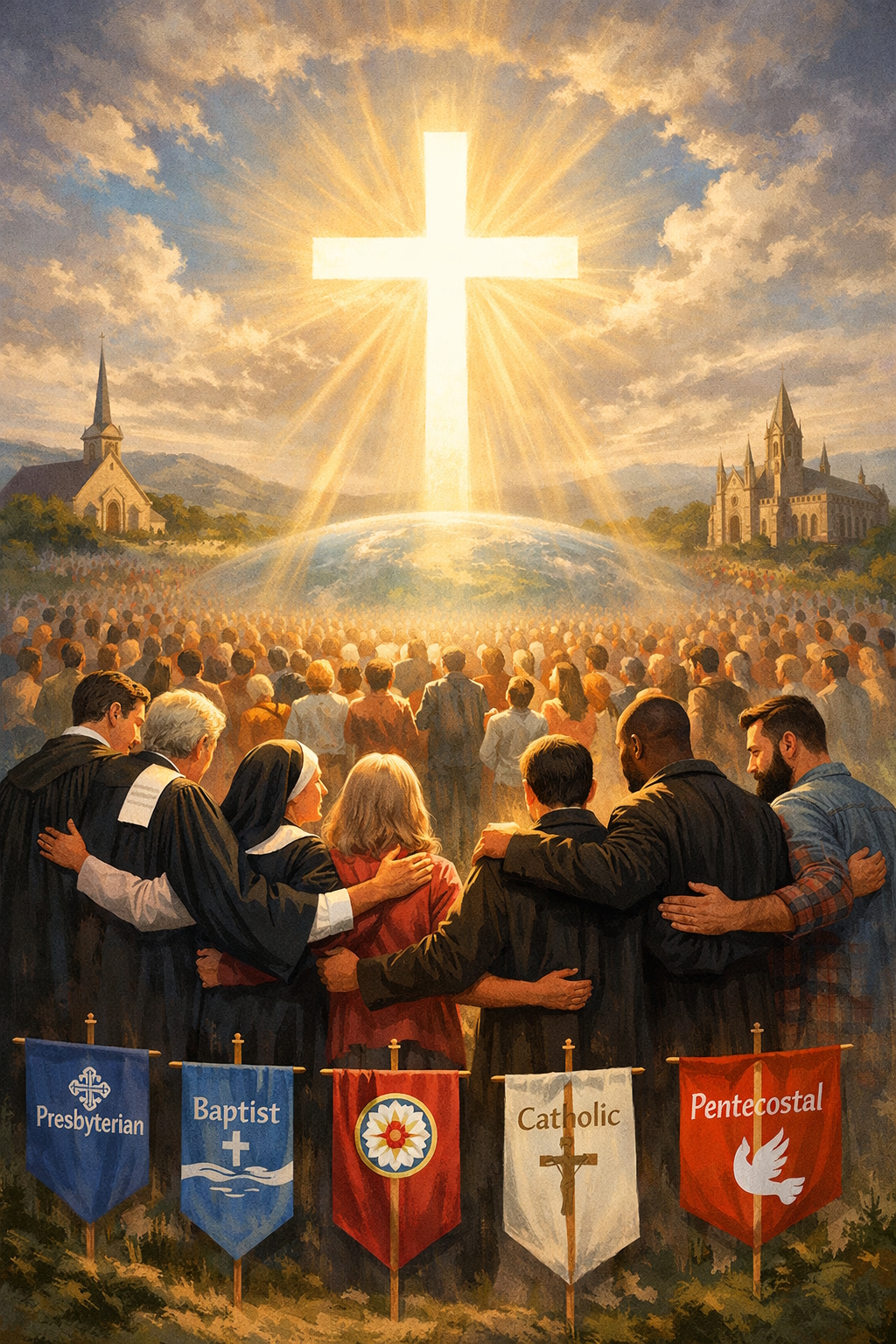
There is a question that reveals more than it asks. When Christians meet for the first time, the enquiry often comes quickly: What denomination are you? The question is understandable. It provides a shorthand for theological positioning, worship style, and ecclesiastical structure. But it also reveals something about how we have come to organise our understanding of the faith. We have learned to sort one another by label before we have learned to recognise one another as family.
This is not how Scripture speaks of the church. When Paul addresses the Corinthians, he confronts a congregation that has begun to fracture along lines of personality and preference. Some claim allegiance to Paul, others to Apollos, others to Cephas, still others to Christ, as if invoking Christ’s name were simply another factional banner. Paul’s response is sharp: Is Christ divided? Was Paul crucified for you? Or were you baptised in the name of Paul? The questions are rhetorical because the answers are obvious. Christ is not divided. No human leader has earned the devotion that belongs to Him alone. To rally around teachers rather than around the one Teacher is, in Paul’s words, to be merely human, to remain in spiritual infancy when maturity should have come.
The parallel to contemporary denominationalism is uncomfortable but unavoidable. The names have changed. Today believers declare, whether explicitly or by the quiet assumptions of tribal belonging, their allegiance to Calvin or Wesley, to Luther or the Pope, to a particular tradition that has become more than a theological home and has begun to function as an identity. The issue is not that these traditions exist. They preserve important truths and provide structures for worship, accountability, and mission. The issue is what happens when the structure meant to serve the gospel becomes a substitute for the gospel itself, when being Reformed or Pentecostal or Catholic or non-denominational becomes the primary marker of who we are rather than a secondary descriptor of how we express what we all share in Christ.
Scripture is relentless in its insistence on the primacy of identity in Christ. Paul tells the Galatians that in Christ there is neither Jew nor Greek, neither slave nor free, neither male and female, for all are one in Christ Jesus. The most fundamental distinctions of the ancient world, categories that defined social standing, legal rights, and personal worth, are relativised by the reality of union with Christ. If ethnicity, status, and gender do not ultimately define the believer, how much less should theological tradition? The new creation that Paul announces in his letter to the Corinthians transcends every earthly category. The old has passed away. The new has come. And the new is hidden with Christ in God, located not in any institution or tradition but in the very life of the Triune God.
This Trinitarian grounding is not incidental. Jesus prayed, on the night before His death, that His followers would be one just as He and the Father are one. The unity He sought was not organisational uniformity. It was a relational oneness modelled on the eternal relationship within the Godhead. The Father, Son, and Spirit are distinct but not divided, united but not undifferentiated. They do not compete. They glorify one another. The church is called to reflect this pattern. When it fails to do so, when believers treat those in other traditions as competitors or strangers rather than as brothers and sisters, the church misrepresents the very nature of the God it claims to worship.
Miroslav Volf, reflecting on what it means for the church to image the Trinity, observed that communion with the Triune God is never private. To be joined to God is to be joined to all others who are joined to God. One cannot have a self-enclosed relationship with a God who is Himself eternal relationship. John Zizioulas, from the Orthodox tradition, pressed the point further: the being of God is relational being. Without the concept of communion, it would not be possible to speak of the being of God at all. If God’s very existence is constituted by relationship, then division in the body of Christ is not merely an organisational failure. It is a theological scandal, a contradiction of what the church is meant to embody.
None of this requires pretending that theological differences do not matter. They do. The church has rightly debated questions of Scripture and salvation, of sacraments and church governance, because truth matters and error has consequences. The Reformation recovered essential biblical teachings that had been obscured, and the cost of that recovery included institutional separation. But the recognition that division was sometimes necessary is not the same as celebrating it or treating it as normal. The multiplication of denominations, often over matters that in retrospect seem minor, represents not strength but weakness, not faithfulness but the persistent human tendency to elevate secondary matters to primary importance.
Lesslie Newbigin, missionary and theologian, offered a helpful corrective. The unity of the church, he argued, is not something we create. It is something given. It is not a human achievement but a divine gift. Our task is not to manufacture unity but to recognise and make visible the unity that already exists in Christ. This is the sevenfold unity Paul describes to the Ephesians: one body, one Spirit, one hope, one Lord, one faith, one baptism, one God and Father of all. The repetition is deliberate. Seven times Paul insists on oneness. Division is not merely unfortunate. It is contradictory to the nature of God and His church. What God has made one, we are called to maintain, not to create from scratch but to preserve in the bond of peace.
The practical implications are significant. When believers meet those from other traditions, the first instinct should not be suspicion but recognition. The brother or sister may worship differently, may understand certain doctrines differently, may practise church governance differently. But if they confess Christ as Lord, if they trust in His finished work, if they have been born of the Spirit, they belong to the same family. Paul’s instructions in Romans 14 apply here. Who are you to pass judgement on the servant of another? It is before his own master that he stands or falls. And he will be upheld, for the Lord is able to make him stand. The believer in another denomination is not our servant to evaluate. They are Christ’s servant, and Christ is able to sustain them.
This does not mean abandoning conviction. It means holding conviction with humility. Every tradition has blind spots. The Reformed tradition, for all its theological rigour, has sometimes tended toward intellectualism that neglects the affections. The charismatic tradition, for all its vitality, has sometimes lacked doctrinal depth. The Catholic tradition, for all its historical continuity, has sometimes elevated tradition in ways that obscure Scripture. The non-denominational movement, for all its flexibility, has sometimes lacked the accountability that structure provides. No tradition has arrived. All are on pilgrimage. The wise believer learns from their own tradition without absolutising it, and learns from other traditions without dismissing them.
Dietrich Bonhoeffer, writing from the context of a church torn by political and theological crisis, reminded believers that Christian community exists through Jesus Christ and in Jesus Christ. No Christian community is more or less than this. The congregation, the denomination, the tradition, these are not the foundation. Christ is the foundation. When any structure begins to compete with Christ for our loyalty, when we find ourselves defending our tribe more passionately than we proclaim our Saviour, something has gone wrong. The structure that was meant to serve the mission has become an obstacle to it.
The ecumenical creeds offer a touchstone. The Apostles’ and Nicene Creeds articulate a faith that predates denominational division and that every orthodox tradition confesses. One holy catholic and apostolic church. The marks belong to the church universal, not to any denomination. When any tradition claims these marks exclusively, it has overstepped. When believers recognise these marks in one another, across denominational lines, they are recognising what Christ has already established. The unity is not an aspiration. It is a reality waiting to be honoured.
There is a pastoral dimension to this as well. Believers who have grown up in traditions that emphasise distinctiveness may feel disoriented by the call to hold their identity more loosely. But the call is not to abandon conviction. It is to order conviction properly. First, we are Christians, united to Christ by faith, indwelt by His Spirit, adopted into His family. Second, we are members of particular communities that express the faith in particular ways. When the second begins to function as the first, when denominational belonging becomes the ground of assurance rather than union with Christ, the order has been reversed and the soul is on unstable ground.
The God we worship is not a denominational God. He is not Anglican or Baptist, Orthodox or Presbyterian. He is the God who is Father, Son, and Holy Spirit, the God who exists in eternal relationship and who invites His people into that relationship. He is the God who prayed for the unity of His people on the night before He died, not because unity is pleasant but because disunity misrepresents Him. He is the God who is grieved when His children quarrel over secondary matters while the world watches, confused about what the church actually believes and whether the love we proclaim is real.
The calling is not to dissolve denominations into a featureless whole. It is to see them rightly, as servants of the gospel rather than competitors for loyalty, as expressions of the one church rather than the whole of it. The believer who holds this perspective can love their tradition without idolising it, can hold convictions without despising those who hold different ones, can worship in their particular community while recognising that the community extends far beyond its walls. This is the freedom of knowing that our identity is secure in Christ, not in any institution. It is the peace of belonging to a family that spans centuries and continents, languages and traditions, a family that will one day gather before the throne with every tribe and tongue, united not by agreement on secondary matters but by the blood of the Lamb.
Until that day, the church lives in tension. Denominations will continue. Differences will persist. But the question each believer must ask is not which label to wear but whom to worship. The answer to that question settles everything else. When Christ is central, traditions become tools. When Christ is marginal, traditions become idols. The difference is not always visible from the outside. But it is known in the heart, and it shapes everything.