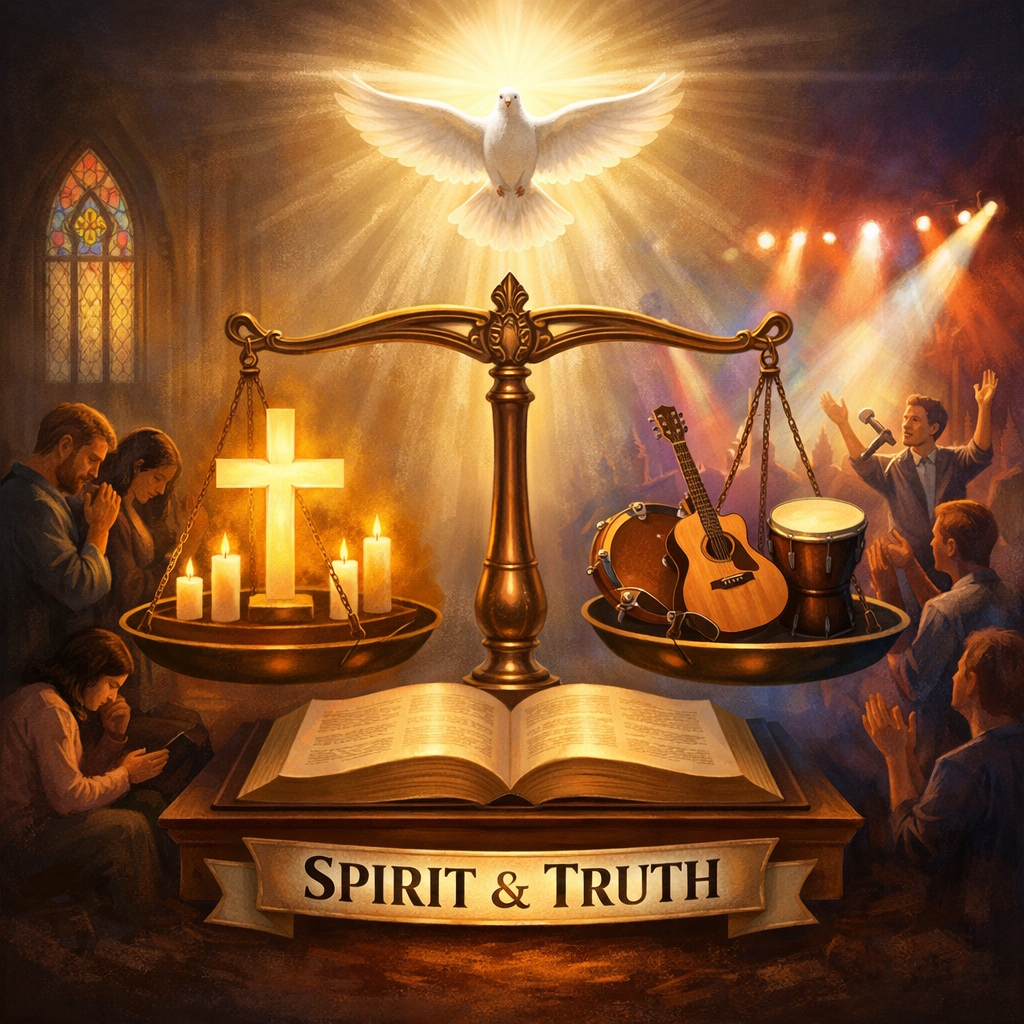
There is a tension in Christian worship that every thoughtful believer eventually encounters. On one side stands the danger of worship so restrained, so carefully managed, that it becomes merely an exercise in religious propriety. On the other stands worship so emotionally charged, so dependent on atmosphere and intensity, that the line between genuine encounter and manufactured feeling disappears. Neither extreme honours the God who calls us to worship in spirit and in truth, yet both have found homes in churches across every tradition.
The early church offers a picture worth returning to. Luke’s description in Acts 2 is notable for what it includes and what it balances. The believers devoted themselves to the apostles’ teaching, to fellowship, to the breaking of bread, and to prayer. There was awe. There were signs and wonders. There was radical generosity and daily gathering. They ate together with glad and sincere hearts, praising God. The portrait is neither sterile nor chaotic. It is ordered but alive, structured but joyful. Teaching and fellowship sat alongside wonder and praise. The mind was engaged; the heart was moved. Neither was sacrificed to the other.
This balance is not accidental. It reflects the nature of the God who is worshipped. He is the God who spoke the universe into existence with precision and order, who set the stars in their courses and established the laws by which creation holds together. He is also the God who delights, who sings over His people, who describes Himself in terms of consuming fire and overwhelming love. A worship that captures only His transcendence becomes cold. A worship that captures only His immanence becomes sentimental. The challenge is to hold both together, to approach the throne with reverence and with confidence, to tremble and to rejoice.
Scripture itself models this integration. The Psalms, which have shaped Jewish and Christian worship for millennia, move between quiet meditation and exuberant praise, between lament and thanksgiving, between careful reflection on God’s law and explosive declarations of His glory. Psalm 46 calls the worshipper to be still and know that He is God. Psalm 150 calls everything that has breath to praise the Lord with trumpet, harp, lyre, tambourine, strings, pipe, and crashing cymbals. The same God receives both. The same worshipper offers both. The question is not whether emotion belongs in worship or whether order does. The question is whether the worship being offered reflects the full range of what Scripture models and what God deserves.
The danger on the side of sterility is ancient. Isaiah records God’s indictment of Israel: These people come near to me with their mouth and honour me with their lips, but their hearts are far from me. Their worship is based on merely human rules they have been taught. The prophets returned to this theme repeatedly. Amos declared that God despised Israel’s religious feasts and would not accept their offerings because their hearts were elsewhere. Malachi confronted a priesthood that went through the motions while offering blemished sacrifices. The external form was maintained, but the internal reality was absent. This is the first ditch into which worship can fall: correct procedure without corresponding affection.
It would be unfair to characterise any particular tradition as inherently guilty of this. Churches that value liturgy, that follow set patterns of prayer and Scripture reading, that prize theological precision in hymns and sermons, are not thereby cold. Some of the most passionate lovers of God have worshipped within the most formal structures. The danger is not the form itself but the possibility that form becomes sufficient, that showing up and saying the words becomes a substitute for genuine encounter. When worship becomes primarily a duty discharged rather than a delight pursued, something essential has been lost.
Yet the opposite danger is equally real. Worship that depends on emotional intensity, that measures its success by the feelings generated, that equates volume and fervour with spiritual depth, can become its own kind of emptiness. Jonathan Edwards, who witnessed both genuine revival and its counterfeits in eighteenth-century New England, distinguished carefully between religious affections and mere emotional excitement. True affections, he argued, arise from a spiritual understanding of divine things. They produce lasting fruit in character and conduct. Counterfeit affections, by contrast, are stirred by atmosphere, music, crowd dynamics, or the charisma of leaders. They feel real in the moment but leave no lasting mark. Edwards was not suspicious of emotion in worship. He considered it essential. But he knew that not every intense feeling was evidence of the Spirit’s work.
The modern worship context has made this distinction more urgent. Advances in lighting, sound engineering, and performance aesthetics have given churches tools that previous generations could not imagine. These tools are not evil. They can serve genuine worship. But they can also manufacture experiences that feel spiritual without being so. The gradual build of a song, the strategic use of lighting, the skilled direction of a worship leader can generate emotional responses that have more to do with technique than with truth. Harold Best, reflecting on decades of leading worship and training worship leaders, cautioned against confusing aesthetic experience with spiritual encounter. Beauty can point to God, but it is not itself God. A moving experience in worship is not self-validating. It must be tested by what it produces and by what truth it rests upon.
This is where the mind and the heart must work together. Paul instructed the Corinthians that he would pray with his spirit and with his mind, sing with his spirit and with his mind. The two are not enemies. The Spirit who moves the heart is the same Spirit who illuminates the mind. Worship that engages only emotion leaves the believer vulnerable to manipulation and to the fading of feeling. Worship that engages only intellect leaves the believer cold and self-satisfied. The goal is a worship in which truth informs affection and affection responds to truth, in which the mind grasps who God is and the heart is moved by what the mind grasps.
James K. A. Smith, writing on the formative power of worship, argues that what we do in worship shapes what we desire. Liturgy, whether formal or informal, trains the heart over time. This suggests that both the structure and the atmosphere of worship matter, not because they guarantee genuine encounter, but because they create conditions in which genuine encounter can occur. A worship service that never pauses for silence may never allow space for reflection. A worship service that never rises to praise may never allow space for joy. A worship service that never includes confession may never allow space for honesty. The rhythms of worship teach the heart what to expect from God and how to respond to Him.
The writer of Hebrews rebuked believers who had remained spiritual infants, still needing milk when they should have been ready for solid food. Maturity in worship, as in all of the Christian life, involves growth. It involves moving beyond the need for constant stimulation and learning to meet God in quiet as well as in celebration. It involves discerning between genuine conviction and emotional manipulation. It involves recognising that the absence of overwhelming feeling is not the absence of God. Mature worshippers can praise God on dry days and on full ones, can engage in liturgy without going through the motions, can sing with passion without needing the music to generate the passion for them.
The solution is not to flatten worship into a single uniform experience. Different gatherings may rightly emphasise different elements. A midweek prayer meeting may be quieter than a Sunday celebration. A service of lament during a season of tragedy will differ from a service of thanksgiving after answered prayer. Cultural contexts shape expression. What looks restrained in one setting may be exuberant in another. The unity is not in uniformity of style but in sincerity of heart, truth of content, and responsiveness to the Spirit who cannot be programmed or predicted.
D. A. Carson, reflecting on worship across Christian traditions, observed that the chief end of worship is not the production of a particular emotional state but the glorification of God through Christ in the power of the Spirit. When that end is kept central, questions of style become secondary. A hymn sung a cappella and a song accompanied by a full band can both glorify God. A spoken liturgy and a spontaneous prayer can both be Spirit-led. The measure is not the form but the heart behind it, not the intensity but the integrity.
For the believer seeking to worship faithfully, the path lies in holding together what the world separates. Let the mind be filled with truth. Let the heart respond to that truth with appropriate affection. Let the body participate, whether in kneeling, standing, raising hands, or quiet stillness. Let the community gather not as an audience but as participants, each bringing their sacrifice of praise. Let the Word be read and preached, the sacraments observed, the prayers offered, the songs sung, not as performances to be evaluated but as offerings to be given. And let all of it be surrendered to the Spirit, who alone can take the imperfect offerings of imperfect people and make them acceptable to a holy God.
Worship is not a technique to be mastered. It is a relationship to be cultivated. The God who receives worship is not indifferent to how He is approached, but neither is He a critic tallying style points. He looks on the heart. He receives the widow’s mite and the king’s abundance. He meets the broken in their tears and the joyful in their dancing. He is not honoured by pretence, whether the pretence of emotion not felt or the pretence of formality not meant. He is honoured when His people draw near with true hearts, in full assurance of faith, and offer themselves to Him as living sacrifices. That is worship in spirit. That is worship in truth. And that is the balance every gathered church and every individual believer is called to pursue.