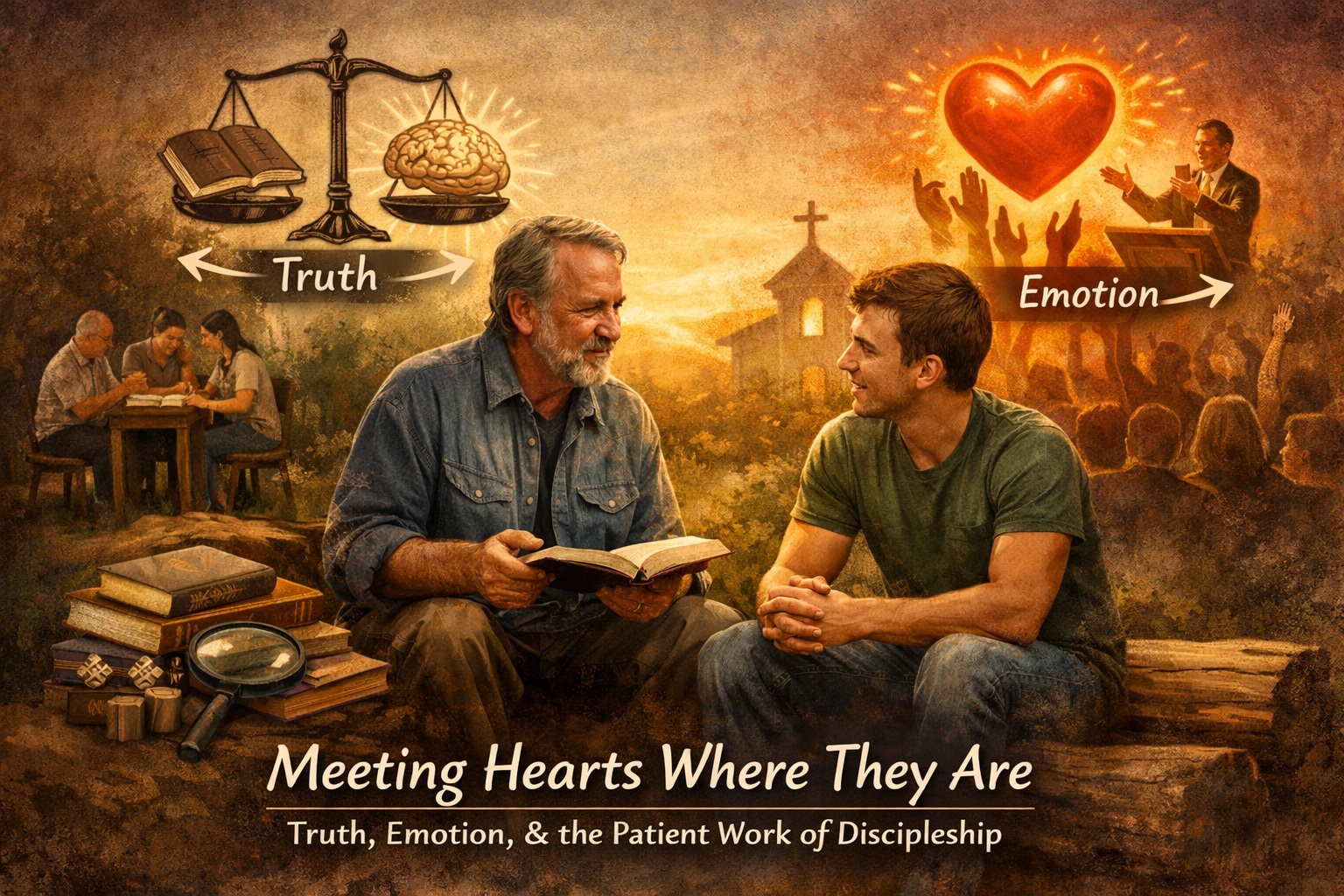
Not everyone comes to faith the same way, and not everyone grows in faith the same way. Some believers are naturally analytical, drawn to careful study, inclined to examine evidence and weigh arguments before reaching conclusions. Others are moved primarily by relationship, by atmosphere, by the emotional resonance of what they encounter. The church has always contained both, and the church has always struggled with how to form disciples who think and feel differently about nearly everything, including how they receive truth.
Scripture does not exempt anyone from the call to discernment. Paul wrote to the Thessalonians that they should test all things and hold fast to what is good. The Greek word he used for test was drawn from metallurgy, the process of examining coins or precious metals to determine their authenticity. John warned his readers not to believe every spirit but to test the spirits to see whether they are from God, for many false prophets have gone out into the world. The Bereans were commended as having more noble character than others precisely because they received Paul’s message with eagerness and then examined the Scriptures daily to see if what he said was true. Eagerness and examination belong together. The one without the other produces either cold scepticism or dangerous gullibility.
Yet the reality is that many believers, sincere in their faith and genuine in their love for Christ, do not naturally engage with teaching in an analytical way. They are not readers. They do not enjoy argument. They are swayed less by the content of what is said than by who is saying it and how it makes them feel. When they encounter a charismatic speaker with confidence and energy, they are captivated. When they are presented with careful reasoning and detailed evidence, they feel overwhelmed, even threatened. This is not a moral failing. It is a difference in how people process information, and the church must reckon with it honestly if it hopes to make disciples rather than merely entertain audiences.
The danger is real. Scripture warns that a time will come when people will not endure sound doctrine but, having itching ears, will accumulate for themselves teachers to suit their own passions. The image is vivid. Itching ears want to be scratched, not challenged. They seek messages that charm rather than convict, that entertain rather than edify. And there is no shortage of teachers willing to provide exactly that. Manipulative leaders understand instinctively that emotional people are easier to sway. They tell stories that trigger feeling. They create atmospheres that overwhelm the senses. They speak with such magnetic energy that listeners are captivated but cannot remember afterward what was actually said. The content does not matter because the experience was powerful, and for many, powerful experience is indistinguishable from truth.
Paul described immature believers as those who are tossed to and fro by every wind of doctrine, carried about by the cunning and craftiness of those who lie in wait to deceive. The nautical imagery suggests a small boat in a storm, lurching violently with every wave, unable to hold a course. This is the condition of the believer who has never learned to anchor themselves in Scripture, who moves from teacher to teacher, trend to trend, always chasing the next experience, the next revelation, the next voice that speaks with enough confidence to sound authoritative. They are not wicked. They are vulnerable. And their vulnerability is exploited by those who know how to manipulate emotion without ever delivering substance.
The solution is not to abandon emotional believers to their fate or to dismiss them as hopeless. Nor is it to overwhelm them with data they cannot process, as if volume of information could substitute for patient relationship. The solution is to meet them where they are without leaving them there, to build trust before expecting transformation, to embody truth in ways that can be seen before it is fully understood.
Jesus did this. He taught in parables, simple stories drawn from everyday life that revealed profound truths. A farmer scattering seed. A woman searching for a lost coin. A father welcoming home a wayward son. These were not academic lectures. They were images that lodged in the imagination and worked their way into the heart over time. Jesus also invested deeply in relationship. He called twelve men to follow Him, and He walked with them daily for years, teaching them not in a classroom but in the ordinary moments of life. They observed how He handled anger, grief, fatigue, and betrayal. They saw His character before they fully grasped His theology. And when they finally understood, it was not because they had won an argument but because they had watched a life.
Paul understood this too. He wrote that he became all things to all people so that by all possible means he might save some. This was not compromise. The message of redemption never changed. But the method of delivery adapted to the audience. When speaking to Jews, he reasoned from the Scriptures they knew. When speaking to pagans who had no knowledge of Scripture, he started elsewhere, with what they could observe and understand. He filtered out cultural trappings to expose diverse groups to the essential truth. And he called believers to imitate him as he imitated Christ, understanding that many things are caught rather than taught, absorbed through example before they are articulated in doctrine.
Augustine, the great teacher of the early church, recognised that a teacher must know his students and adapt his teaching to their level of learning and maturity. He used the image of a mother who feeds her child small morsels rather than large portions, or a father who babbles with his child in shortened words, motivated by love to meet the child where he is. This is not condescension. It is wisdom. The goal is not to keep the child an infant forever but to nourish growth at a pace the child can handle. Gregory the Great, writing on pastoral care, identified dozens of different kinds of persons who required different kinds of exhortation. The meek needed different counsel than the passionate. The humble needed different encouragement than the haughty. The doctrine was the same. The application varied.
John Wesley built his Methodist movement on this insight. Preaching alone was not enough. It awakened people, but it did not sustain them. So Wesley created class meetings, small groups of about a dozen people who met weekly for accountability, encouragement, and mutual support. These were not Bible studies in the academic sense. They were communities where faith was practiced and observed, where struggles were confessed and progress was celebrated, where the truth became concrete in shared life. Wesley understood that many people would never grow through reading alone. They needed to see faith lived and to be held accountable by others who cared about their progress.
This is the patient work of discipleship. It cannot be rushed. It cannot be forced. The writer of Hebrews lamented that his readers were still infants, needing milk rather than solid food, when by now they ought to have been teachers themselves. But the solution was not to dump solid food on those who could not digest it. The solution was to train their faculties through constant practice to distinguish good from evil. Training takes time. Practice requires repetition. The mature believer who wants to help the immature must be willing to walk slowly, to repeat what has already been said, to demonstrate what has already been taught, to trust that growth will come even when it cannot yet be seen.
There is a particular danger in the modern church, where platforms and personalities can reach millions without any relational accountability. The emotional believer who follows a charismatic teacher online may never have their assumptions challenged. They may never encounter a mature Christian who knows them well enough to ask hard questions. They may absorb hours of content that sounds spiritual but lacks substance, and they will defend it fiercely because it made them feel something. The answer is not to shout louder or argue more forcefully. The answer is presence, relationship, the slow and unglamorous work of walking with people over time, earning the right to speak into their lives by first demonstrating that you care about them as persons, not as projects.
The Dunning-Kruger effect, well documented in psychological research, describes the tendency of those with limited knowledge to overestimate their competence while those with greater knowledge recognise how much they do not know. Ignorance breeds confidence. Learning breeds humility. This dynamic plays out constantly in spiritual conversations. The believer who has read one book or followed one teacher may speak with absolute certainty about matters that scholars have debated for centuries. The believer who has studied deeply is more likely to acknowledge complexity and nuance. Humility is not a weakness. It is the mark of someone who has actually engaged with the depth of what they claim to believe.
The calling for mature believers is not to win arguments but to make disciples. This requires patience, the fruit of the Spirit that trusts God’s timing rather than demanding immediate results. It requires gentleness, the willingness to speak truth without weaponising it. It requires the long obedience in the same direction that Eugene Peterson described, the commitment to walk with people through seasons of confusion and growth, setback and breakthrough, doubt and deepening faith. It requires the recognition that God is already at work in the lives of those we seek to help, and that our role is not to replace His work but to cooperate with it.
Truth matters. Emotion is not a substitute for doctrine, and experience is not a replacement for Scripture. But truth delivered without love is noise, and doctrine without relationship is dead. The goal is not to choose between head and heart but to form whole persons who think clearly and feel rightly, who test all things and hold fast to what is good, who are no longer tossed by every wind but are anchored in Christ. This is the patient work of discipleship. It takes longer than a sermon. It costs more than a conference. But it produces believers who can stand, and who can help others stand after them.