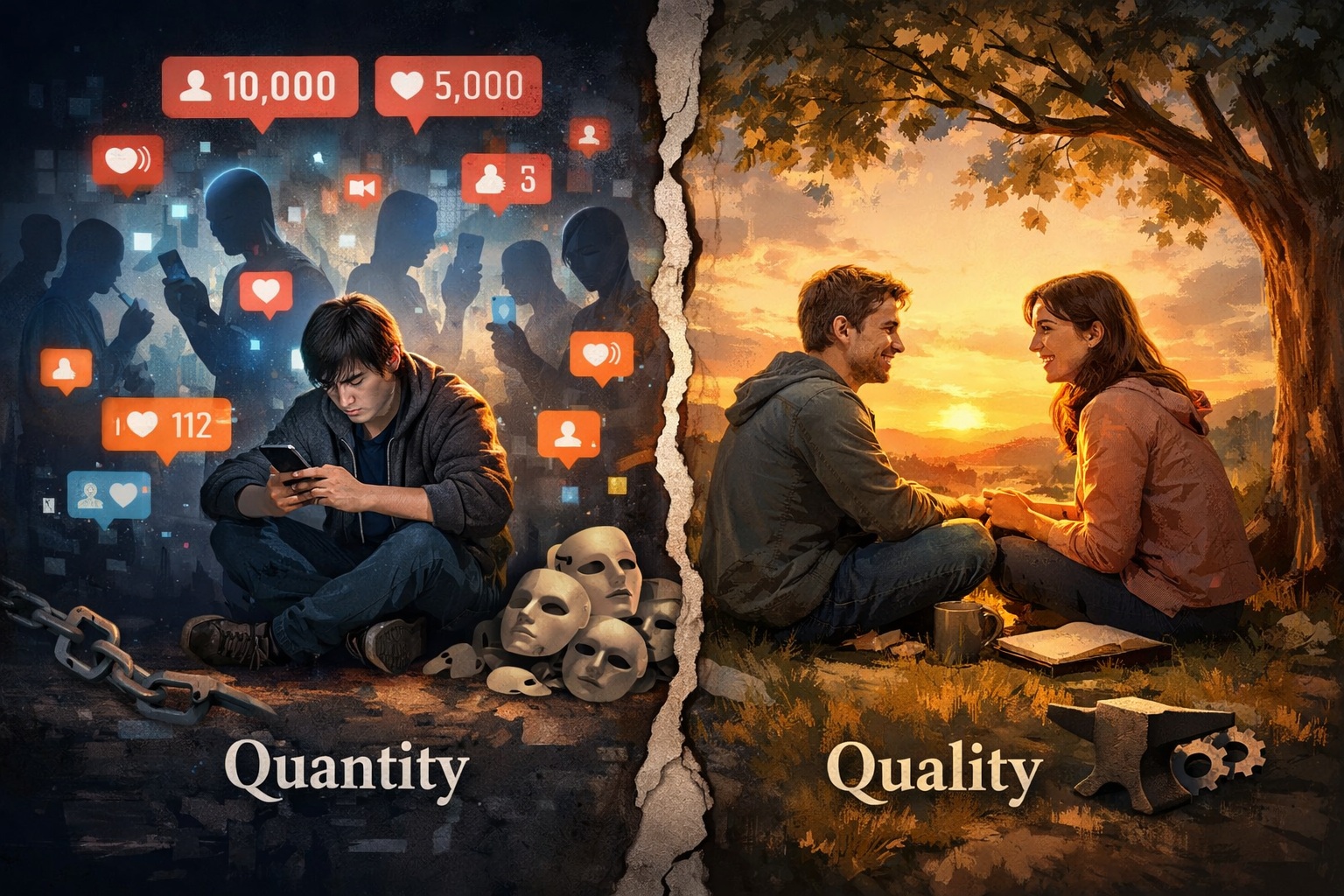
There is an ancient proverb that warns of a danger most modern people would not recognise as dangerous at all. One who has unreliable friends soon comes to ruin, but there is a friend who sticks closer than a brother. The warning is not against friendship. It is against the accumulation of companions, the gathering of many without regard for depth. The Hebrew suggests that the person who multiplies acquaintances without discernment invites their own destruction. In an age when a teenager can amass thousands of followers with a single post, when the word friend has been redefined to include people one has never met, the proverb speaks with a clarity that should unsettle anyone paying attention.
The shift has been dramatic and it has been fast. Young people today spend an average of nearly five hours a day on social media. Add to that the hours consumed by gaming and social video platforms, and the picture that emerges is one of a generation whose waking life is increasingly lived through screens. Jonathan Haidt, in his research on adolescent mental health, documented the consequences. Between 2010 and 2018, anxiety among young people rose by 134 per cent and depression by 106 per cent. These are not small fluctuations. They represent a fundamental change in the inner lives of an entire generation, and the timeline corresponds precisely with the mass adoption of smartphones and social media. The correlation does not prove causation on its own, but when combined with the neuroscience of how these platforms operate, the picture becomes difficult to dismiss.
Short-form video platforms, the ones that consume the largest share of adolescent attention, are engineered to exploit the brain’s dopamine reward system. Each scroll delivers a micro-hit of novelty, training the brain to seek more, to stay longer, to resist the impulse to put the device down. Meta-analyses have found that consumption of short-form video is associated with poorer cognitive performance, particularly in attention and inhibitory control. The brain is not resting during these hours. It is being trained, but trained in the wrong direction, trained to flit rather than focus, to consume rather than create, to react rather than reflect. The person who spends three hours a day watching other people’s content is not developing. They are being developed, shaped by algorithms designed not for their flourishing but for the platform’s revenue.
Gaming presents a similar concern. The average adolescent now spends nearly three hours a day in digital games. Not all gaming is mindless, and not all screen time is wasted. But the majority of studies report negative associations between heavy gaming and academic performance, social development, and physical health. When gaming becomes the primary leisure activity, when it displaces reading, conversation, physical play, and creative pursuit, the opportunity cost is enormous. The hours spent are hours that cannot be recovered. They are hours that might have been given to learning a skill, reading a book, developing a talent, or simply being present with the people in one’s life.
Paul wrote to the Ephesians that they should be very careful how they lived, not as unwise but as wise, making the most of every opportunity because the days are evil. The Greek word for making the most is exagorazo, which means to buy back, to redeem. It carries the sense of reclaiming something that has been lost or stolen. Time, in Paul’s understanding, is not neutral. It can be redeemed or it can be squandered. The days are evil not because every moment is threatening but because the prevailing patterns of the age work against wisdom, against depth, against the purposes of God. To redeem the time is to resist those patterns, to choose deliberately what the culture chooses carelessly, to invest hours in what builds rather than what merely entertains.
This is not a call to joyless productivity. Scripture celebrates rest, feasting, play, and beauty. The Sabbath itself is built into creation as a gift, not a punishment. But there is a difference between rest that restores and consumption that deadens. The person who spends an evening in genuine conversation with a friend has rested. The person who spends an evening scrolling through a feed of strangers’ curated lives has not. The first emerges refreshed. The second emerges emptier than they began, often without knowing why.
The pursuit of popularity deserves particular examination. Mitch Prinstein, a psychologist who has studied the dynamics of social standing for decades, distinguishes between two kinds of popularity: likability and status. Likability is the quality of being genuinely valued by others, the warmth and trust that characterise real friendship. Status is visibility, dominance, influence, the currency of social media. The research is striking. Likability, cultivated in adolescence, predicts positive outcomes across the lifespan: stronger relationships, better mental health, greater professional satisfaction. Status, by contrast, predicts the opposite. Those who pursued status in their youth were more likely to experience aggression, addiction, and despair even decades later. The metrics of social media, followers, likes, shares, are all status markers. They measure visibility, not connection. They count audience, not friendship. And the young person who organises their life around accumulating these metrics is building on a foundation that will not hold.
Solomon reflected on this with characteristic directness. Two are better than one, because they have a good return for their labour. If either of them falls down, one can help the other up. But pity anyone who falls and has no one to help them up. The image is practical and physical: someone who stumbles on the road needs a hand, not an audience. A thousand followers cannot lift you when you fall. A single genuine friend can. The writer of Proverbs observed that iron sharpens iron, that one person sharpens another, and the implication is that depth of relationship produces growth in ways that breadth of acquaintance never can. Robin Dunbar’s research on the cognitive limits of social connection confirms this. The human brain can maintain approximately 150 meaningful relationships, layered from an innermost circle of roughly five intimate bonds outward through successively less close connections. Having thousands of online contacts does not expand this capacity. It dilutes it, drawing attention away from the relationships that actually matter toward the maintenance of connections that exist only as names on a screen.
C. S. Lewis, reflecting on the nature of friendship, called it the most neglected love in the modern world. Friendship, he wrote, has no survival value. Rather, it is one of those things which give value to survival. It is born at the moment when one person says to another, What? You too? I thought I was the only one. This cannot happen in a feed. It cannot happen between a person and a screen. It requires presence, vulnerability, the willingness to be known rather than merely seen. The digital world offers the illusion of connection while systematically undermining the conditions that make genuine connection possible.
Bonhoeffer warned that the person who loves their dream of community more than the community itself becomes a destroyer of that community. The curated personas of social media are precisely the kind of visionary dreaming he had in mind. They present not real selves but polished images, and the relationships built on those images are correspondingly thin. When the image cracks, as it always does, there is nothing underneath to sustain the bond. Real friendship survives failure, disappointment, and ordinariness. Digital connection rarely does.
For young people, the implications are practical and urgent. The hours given to scrolling, gaming, and chasing metrics are hours not given to the pursuits that build a life. Reading, which research has causally linked to increased brain volume in regions essential for cognitive control, language, and executive function, has declined sharply among adolescents. Creative skill-building, once the natural occupation of youth, competes poorly with the instant gratification of a feed designed to hold attention. Conversation, the ancient art through which wisdom is transmitted and character is formed, happens less as screens fill the silence. The young person who emerges from adolescence having invested thousands of hours in passive digital consumption will not have the same cognitive, social, or spiritual resources as the one who invested those hours in reading, creating, relating, and praying.
Romans 12 urges believers not to conform to the pattern of this world but to be transformed by the renewing of their minds. The pattern of this world, in our age, is distraction. It is the relentless pull toward the shallow, the fleeting, the immediately gratifying. The renewal of the mind moves in the opposite direction: toward depth, toward patience, toward the slow formation of character that comes only through sustained attention to what is true, noble, right, pure, lovely, and admirable. This is not a luxury for the intellectually inclined. It is the calling of every believer, the daily discipline of choosing what is meaningful over what is merely available.
The choice between quality and quantity is not limited to friendships. It extends to how we spend our time, what we give our attention to, and what we allow to shape our inner lives. A few deep friendships are worth more than a thousand shallow ones. An hour of genuine learning is worth more than a day of passive scrolling. A life built on substance, on real connection, on the slow development of the person God made us to be, will stand when the metrics have been forgotten and the feeds have gone dark. The writer of Proverbs knew this. Walk with the wise and become wise, for a companion of fools suffers harm. The company we keep and the way we spend our hours are not neutral. They form us, for good or for ill. The question is not whether we will be shaped, but by what.
Augustine confessed that our hearts are restless until they rest in God. The restless scrolling, the compulsive checking, the endless chase for one more like, one more follower, one more moment of digital validation, these are symptoms of a heart that has not yet found what it is looking for. No feed can satisfy it. No algorithm can calm it. The rest that the soul craves is found in presence, in depth, in the kind of knowing and being known that screens cannot provide. It is found in the friend who stays when things fall apart. It is found in the quiet hour given to something that matters. It is found, ultimately, in the God who does not scroll past us but stops, sees, and calls us by name.