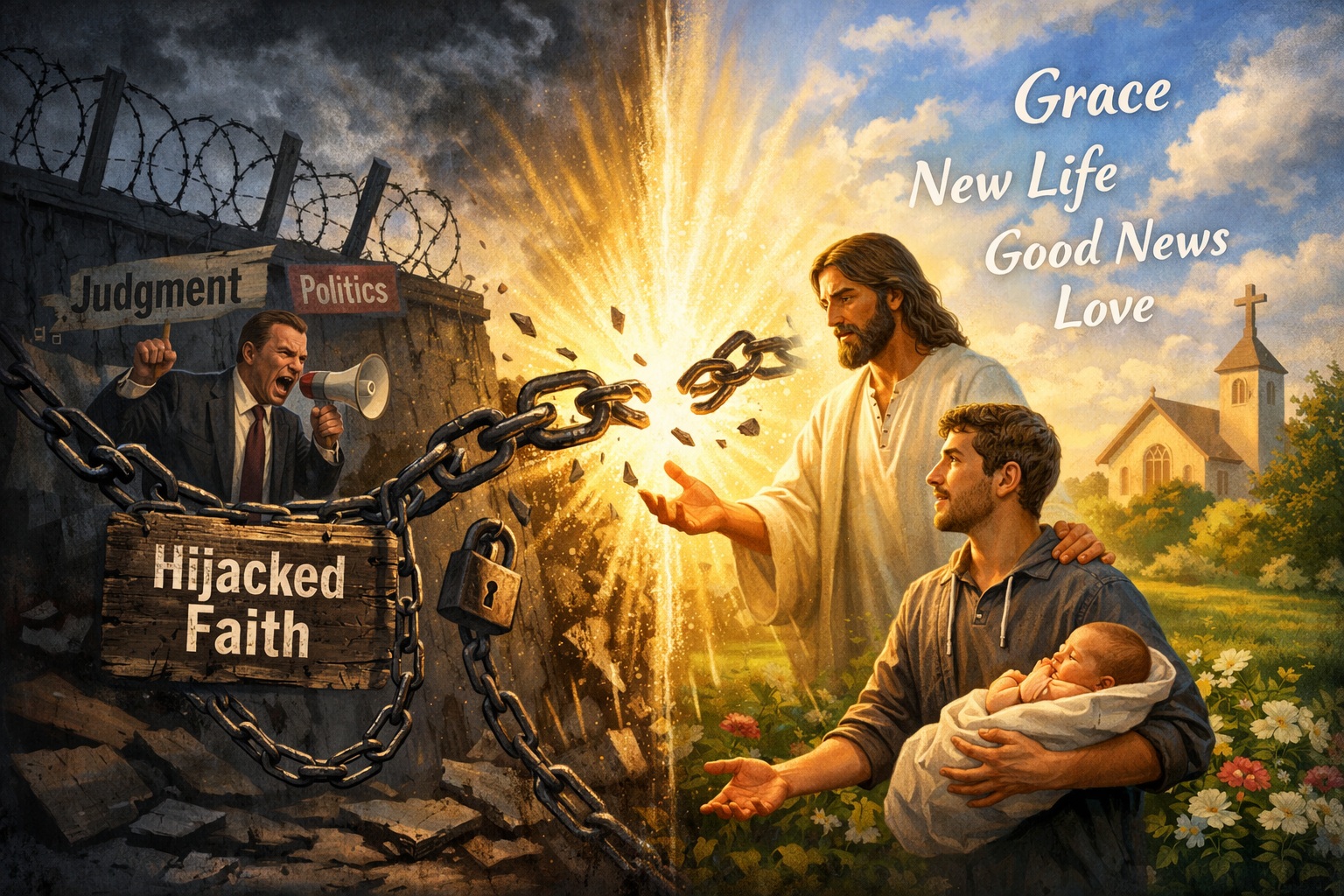
There are words that belong to the church, words rooted in Scripture and laden with meaning, words that for centuries carried the weight of salvation and mission and new life. And yet, in the hands of particular movements and in the drift of cultural perception, these words have been taken hostage. They have been made to mean something narrower, something stranger, something off-putting to the very people they were meant to reach. The task before thoughtful believers is not to abandon these words but to reclaim them, to return them to their scriptural soil and let them bear the fruit they were always meant to bear.
Consider the phrase born again. In contemporary usage, it conjures a very specific image: the zealous convert, the street-corner preacher, the person who has traded one form of rigidity for another and now stands in judgment of everyone who has not had the same dramatic experience. To be called a born-again Christian, in many circles, is to be labelled closed-minded, overly confident, and judgmental. The phrase has become shorthand for a particular kind of religious righteousness that imposes strict boundaries and brooks no questions.
Yet the term comes from Jesus Himself. In His nighttime conversation with Nicodemus, a Pharisee and member of the ruling council, Jesus declared that no one can see the kingdom of God unless they are born again. The Greek word anothen carries a double meaning: again and from above. Both senses are true. Jesus was not describing a technique or an emotional experience. He was describing a transformation of the heart, a second birth that comes not from human effort but from the Spirit of God. As Peter later wrote, believers have been born again not of perishable seed but of imperishable, through the living and enduring word of God. The new birth is not self-rescue. It is mercy. It is grace. It is divine life given to the spiritually dead. The baby does not cause the birth.
The irony is bitter. The very image of being born again implies a posture of humility, wonder, and openness, the posture of an infant who has nothing to offer and everything to receive. And yet the term has been co-opted by those whose demeanour suggests the opposite: certainty without gentleness, confidence without listening, conversion without ongoing transformation. The word has been hijacked, not by enemies of the faith, but by those who claim it most loudly.
The same has happened to evangelical. The word derives from the Greek euangelion, meaning good news. At its root, it simply describes someone who shares the gospel. In the Reformation, Martin Luther preferred the term evangelical to Lutheran because it pointed not to a human leader but to the message itself. The early Protestant movements in Germany and beyond were called evangelical because they insisted on teaching in accordance with the Gospels. For centuries, the word carried this meaning: a Christian committed to the authority of Scripture and the proclamation of the good news of Jesus Christ.
But in the latter half of the twentieth century, particularly in America, the word underwent a transformation. The founding of the Moral Majority in 1979 marked a decisive moment. Evangelical became entangled with political activism, with a particular party, with a particular set of social positions. Polling organisations began asking whether respondents identified as evangelical or born again, and in doing so cemented a category that had as much to do with voting patterns as with theology. By the 2010s, most casual observers had come to assume that evangelical meant white religious Republican. The word that once pointed to the good news now pointed, for many, to partisan activism.
This is not merely a matter of public relations. It is a theological loss. When a word that means good news becomes associated primarily with political tribalism, something essential has been stolen. The mission of the church, the very reason the word existed, gets buried beneath cultural baggage. Younger Christians increasingly reject the label even when they hold the convictions it was meant to represent. The spiritual identity has been hijacked by political reductionism.
Even the word Christian itself has not escaped. The disciples were first called Christians at Antioch, according to Acts 11. The term was given by outsiders, probably as a way of identifying this strange new group that was neither fully Jewish nor pagan. The suffix -ian indicated belonging to the party of, so Christians were those who belonged to Christ. Some scholars believe the citizens of Antioch, known for their sarcasm, may have coined it as a term of mockery: the little Christs. And yet the church embraced the name. To be a little Christ was precisely the point. C. S. Lewis would later write that the church exists for nothing else but to draw men and women into Christ, to make them little Christs. If they are not doing that, all the cathedrals, clergy, missions, and sermons are simply a waste of time.
But now the word Christian carries its own weight of negative association. In media portrayals, Christians are frequently depicted as judgmental, ignorant, and empty of grace. Research suggests that a majority of stories about faith in entertainment are negative, sensational, or divisive. The word that once meant follower of Christ now means, for many outside the church, hypocrite who judges others while ignoring their own failures. The name has been tarnished not only by external misrepresentation but by internal failure, by the gap between what Christians profess and how they are perceived to behave.
Scripture takes words seriously. Proverbs teaches that life and death are in the power of the tongue. Jesus Himself warned that on the day of judgment, people will give account for every careless word they speak. Words are not neutral containers. They carry meaning, and meaning shapes perception, and perception shapes whether people will listen at all. When the words that should point to life instead point to judgment, when the words that should invite instead repel, something has gone wrong, and the church must take responsibility for setting it right.
Reclaiming these words does not mean fighting a semantic war or insisting that others use them correctly. It means living in such a way that the original meaning becomes visible again. When someone who has been born again lives with the humility and wonder of a newborn rather than the arrogance of one who has arrived, the phrase begins to recover its meaning. When someone who shares the good news does so with gentleness, patience, and genuine love rather than with political agenda and tribal loyalty, the word evangelical starts to point back toward euangelion. When someone who bears the name Christian actually resembles Christ, who was full of grace and truth, who ate with sinners and touched lepers and reserved His harshest words for the religiously proud, the name starts to mean what it was always meant to mean.
This is not a call for better branding. It is a call for faithfulness. The words belong to Scripture, and Scripture defines what they mean. Being born again is not a personality type or a political position. It is the universal Christian reality, the moment when the Spirit brings dead souls to life. Evangelism is not Bible-bashing or culture-warring. It is the simple, joyful sharing of news so good that it must be told. Being a Christian is not membership in a cultural tribe. It is apprenticeship to Jesus, the slow and often painful process of becoming like Him.
The church cannot control how outsiders use these words. But it can control how it embodies them. Every believer who lives with genuine humility, who speaks with gracious honesty, who loves without condition and serves without fanfare, is doing the quiet work of reclamation. They are showing the world what the words actually mean. And in a culture drowning in cynicism about religious language, that embodiment may be the only dictionary anyone is willing to read.
The words have been stolen. But words can be returned to their rightful meaning, one life at a time, one community at a time, one generation at a time. The task is not to argue about definitions. It is to live them. And in that living, to let the world see what it has been missing all along.