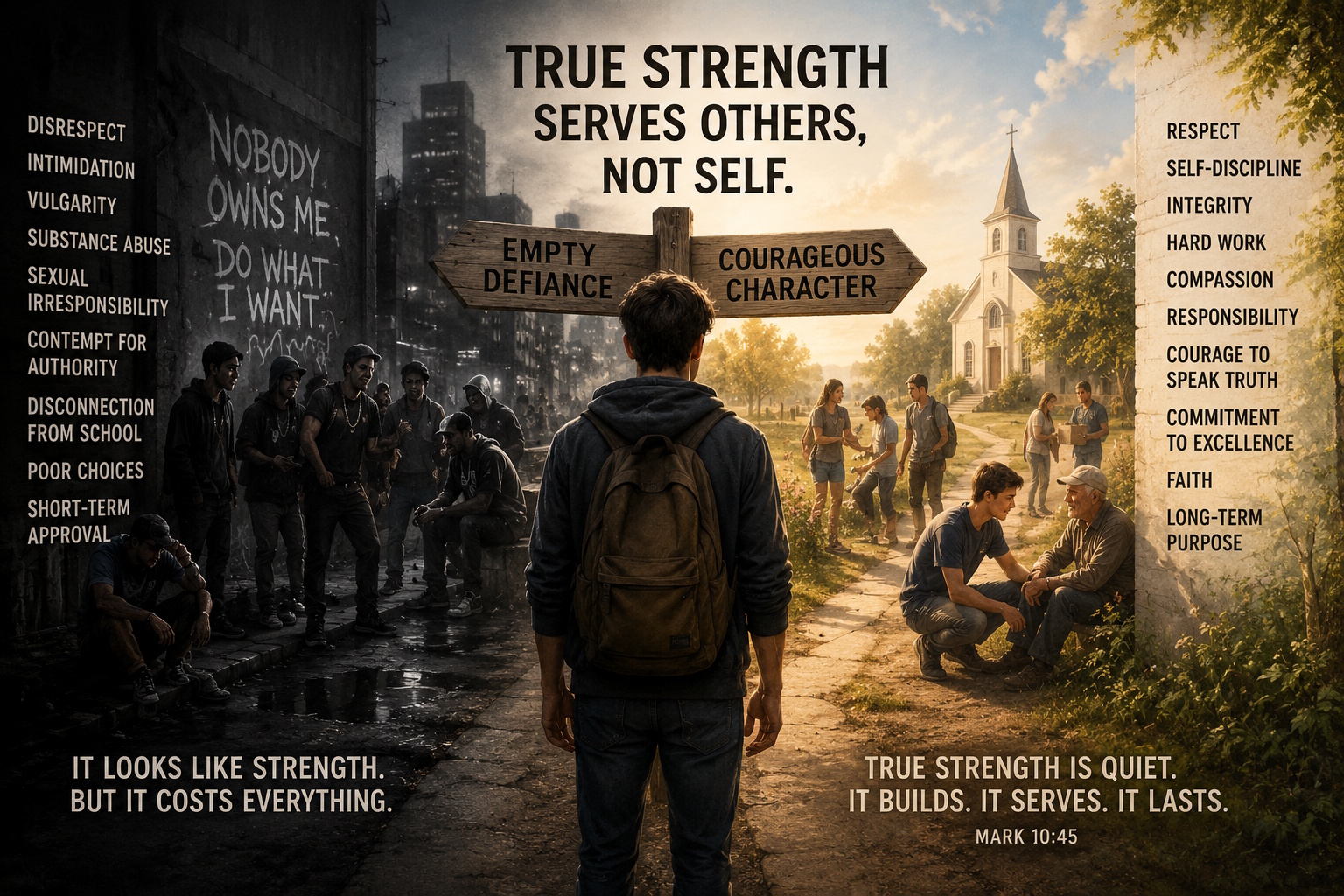
A boy stands at a mirror, practising a walk. He has studied it for weeks. The roll of the shoulders, the flat stare, the words bitten off short so that nothing sounds like it cost him anything. None of it is his. He assembled it from a screen, and tonight he will wear it into a room where he is afraid of being nobody. He is not a bad child. He is a child who has been sold something, and the price will never appear on any receipt he sees.
There is an important difference between legitimate nonconformity and a culture that celebrates antisocial behaviour, and nearly everything depends on holding the two apart. Healthy nonconformity challenges corruption, injustice or empty convention. What is marketed to that boy is something else. Disorder, intimidation, vulgarity, substance abuse, sexual irresponsibility, contempt for education and hostility towards authority are presented to him as proof of authenticity, liberation and strength. The presentation is skilled, and it is not accidental. It is a product, and he is not its customer but its consumer, which is a poorer thing to be.
Christians should be slow to sneer at nonconformity, because our Lord was not a conformist. He overturned tables in the temple courts and told the traders to stop turning his Father’s house into a market. He healed on the Sabbath in front of men who were watching for exactly that, and asked why a daughter of Abraham, bound for eighteen long years, should not be set free on the Sabbath day. But notice the shape of his defiance. It was done in the open. It was done for someone else, or for his Father’s honour. And it cost him, for Mark records that the men he angered went out at once to plot his death. The same three marks are on the young men in Babylon who would not bow to the golden image. The whole weight of their refusal rests in one clause: but even if he does not. They claimed no guarantee of rescue. Selfish defiance reverses all three. It is performed rather than open, it serves the self, and its cost lands on somebody who did not choose it. That is the line between the prophet and the vandal, and a generation that is never taught it will not find it by instinct.
Clothing alone does not determine character, nor is poverty a moral failing, and Scripture is blunter about this than we tend to remember. James imagines a rich man in fine clothes and a poor man in filthy old clothes entering the same meeting, and it is not the shabby one the congregation is warned about. If they fuss over the fine suit, James says, they have become judges with evil thoughts. Contempt is contempt whichever way it travels. The danger lies elsewhere. It arises when deliberate slovenliness, threatening presentation and public disrespect are adopted as badges of contempt for ordinary standards, when the whole point of the appearance is to announce that other people do not matter. Being neat and presentable is not submission or weakness. It is usually an act of self-respect, and of consideration for the people with whom one shares schools, workplaces, churches and public spaces. Paul told the Thessalonians to make it their ambition to lead a quiet life and to work with their hands, so that their daily lives would win the respect of outsiders. An ambition to be still. And when Paul reaches for a clothing image of his own, he tells the Colossians to clothe themselves with compassion, kindness, humility, gentleness and patience, and over them all to put on love. Something is always being worn. The only question is what.
The same holds for lawful authority. Authority can be abused, and it must never be treated as morally infallible. When the apostles were ordered to stop preaching, Peter answered that we must obey God rather than human beings, and the church has needed that sentence ever since. Yet families, schools, churches, workplaces and communities cannot function without legitimate rules, discipline and reciprocal respect, and the same Peter who defied a council also told believers to show proper respect to everyone. Both sentences are his. Both are Scripture. When every correction is called oppression and every restraint an attack on freedom, young people lose the ability to distinguish principled resistance from selfish defiance, and they lose it at the very age when they most need it. A boy who has never been taught the difference between Daniel and a tantrum will call whatever thwarts him tyranny.
How does a costume become a character? Research on juvenile delinquency consistently identifies association with delinquent peers, antisocial attitudes, poor parental supervision, substance use, weak attachment to school and low educational commitment among the significant risk factors. But the mechanism is quieter than any list. When researchers filmed teenage boys talking with their friends, they noticed something in the pairs who later got into trouble. Talk of breaking rules was met with laughter, and the laughter drew more of the talk, until misbehaviour had become the common ground on which the friendship itself stood. They called it deviancy training. The reward was not money or fear. It was warmth. It is why the young so rarely offend alone, and why attitudes travel from companion to companion like a language. It is also why gathering troubled boys together to be lectured or frightened has so often made them worse rather than better. What begins as language, clothing, music or an online identity can become a complete moral framework, not because anyone decided it should, but because a group rewards what it enjoys.
The songs themselves matter less than the friends who share them. A playlist is mostly a badge. But it is worth saying plainly which content deserves the concern, because it is not the swearing. The line worth drawing is between the degrading and the merely coarse. Songs that treat a woman as a commodity keep company with violence in a way that merely explicit songs do not, and they leave a mark on young listeners that ordinary love songs never leave. The trouble with such music was never the blush it causes. It is the contempt it teaches, for women, for neighbours, for the law, for the ordinary decencies by which people manage to live together.
And the culture is a business. Researchers who tracked two decades of charting songs watched references to alcohol multiply several times over, watched brand names crowd into the lyrics as the marketing money arrived, and watched violence change from a danger the singer survived into a glamour he wore. Rebellion sells, and it has been sold to the young by respectable companies for the better part of a century. But the celebrity selling it rarely bears the consequences of it. The performer has wealth, security, lawyers, managers and commercial contracts. The young follower collects the criminal record, the addiction, the broken relationships, the lost schooling and the closed doors. In one famous audit, matched young men applied for the same entry-level jobs, identical in every respect but one, and the criminal record alone halved their chances of a call back. And the young men whose own lyrics are now read out against them in courtrooms are mostly amateurs imitating a commercially successful product. The celebrity markets rebellion as a product. The consumer pays for it with his future.
Nor is any of this the property of one people. Britain had its Teddy Boys and its mods and rockers. Russia has its gopniks, Japan its bosozoku, Australia its eshays. Johannesburg and Soweto had the tsotsi, who most likely took his very name from the American zoot suit that Hollywood sold him. Different countries, different languages, different decades, the same costume. The reckless years arrive on much the same schedule in every culture that has been measured, and wherever they arrive, somebody is waiting to sell the uniform.
Parents may see only fragments of the transformation. An adolescent can keep one identity for home and another for friends and screens, and by the time the secrecy, the slipping marks, the aggression or the new companions become visible, the young person may already regard his parents’ concern as betrayal by an enemy. Here the research offers parents an unexpected kindness. When Swedish researchers examined what parents actually know about their teenagers, the knowledge turned out to come mainly from what the child chooses to tell. It was that free disclosure, not surveillance, that walked with staying out of trouble. Watching tells you less than being trusted does. A young person performs a false self when he suspects the real one will not be received. So the door must be kept open at precisely the moment a parent least feels like it, and the standard held at precisely the moment it is least welcome. Neither on its own is love.
Much of the bravado is not strength at all. It is an insecurity mask, an attempt to obtain identity, belonging and status without first developing competence, character or self-command. The men who do the most harm are not those secure in their manhood but those who fear they fall short of it and cannot bear the gap. Researchers who followed the cool thirteen-year-olds into adulthood found that the early swagger bought a brief admiration and a long bill. By their twenties they were doing worse, not better, and the summary was almost pitiable: they needed more and more extreme behaviour to go on seeming impressive. Status won by transgression must be re-earned at a higher price every year. Real strength is harder and much quieter. It studies while others mock effort. It stays sober while intoxication is celebrated. It treats women and men with dignity, holds its temper, accepts correction, and pursues excellence without the applause of the crowd. Proverbs gave the trophy away long ago, and gave it to the wrong man on purpose. Better a patient person than a warrior, one with self-control than one who takes a city. Paul’s entire charge to young men in Titus is a single clause. Encourage the young men to be self-controlled.
Beneath the swagger sits something older than any marketplace, which is the terror of being outside. C. S. Lewis called it the Inner Ring, and said that of all the passions it is the most skilful at making a man who is not yet a very bad man do very bad things. You are drawn in, he said, not by greed, but because at that moment you cannot bear to be thrust back into the cold outer world. And the Ring lives by exclusion. There would be no pleasure inside if there were nobody outside. Augustine told the same story on himself sixteen centuries earlier. He and his friends stripped a pear tree they did not want and threw the fruit to pigs, and the grown bishop, searching his memory, could find no motive but the theft itself. It was foul, and I loved it, he wrote. Then comes the sentence that explains half of adolescence: alone, he would never have done it. And of the moment when the group says let us go, let us do it, he wrote that we are ashamed not to be shameless. Deviancy training, confessed from the inside, in the fourth century.
So the cycle closes on itself. A culture that claims to resist exclusion recruits the young into the very conduct that deepens exclusion: educational failure, family breakdown, distrust, violence, addiction, unemployment. Proverbs watched the recruitment happen three thousand years ago. Sinful men entice a young man with belonging and an equal share. Come along with us, cast lots with us, we will all share the loot. And the father’s verdict stands over every gang and every feed that has copied the pitch since: these men lie in wait for their own blood; they ambush only themselves. External injustice may be real. But destructive behaviour does not defeat it; it gives it another generation in which to operate. Both of those sentences are true, and neither cancels the other.
For Christians the issue runs deeper than respectability. When Paul warned the Corinthians that bad company corrupts good character, he was quoting a pagan comedy, a line of Menander’s that the whole culture knew. He did not quarantine his converts from the world around them. He engaged it, and kept whatever in it was true. Basil the Great told his students to be like bees among the flowers, taking the honey and leaving the rest. The church’s quarrel is not with the young or their music. It is with a lie, and Peter named the lie once and for all: they promise them freedom, while they themselves are slaves of depravity, for people are slaves to whatever has mastered them. I have the right to do anything, said the Corinthians. But I will not be mastered by anything, said Paul. Everyone serves something. The only question is what. Jesus said it to men who insisted they had never been slaves of anyone, which is exactly what this culture teaches a boy to say. Everyone who sins is a slave to sin. And if the Son sets you free, you will be free indeed. Christian freedom is not freedom from discipline. It is freedom from slavery to appetite, anger, pride, fear and the approval of the crowd. There is a last irony worth savouring. Paul’s word for the problem was never rebellion. It was conformity. Do not conform to the pattern of this world, but be transformed by the renewing of your mind. A culture that sells itself as rebellion is, up close, a demand for conformity enforced by ridicule. The genuinely nonconformist act is to decline it.
None of this is a verdict on anybody’s son. Most young people who pass through a defiant season come out the other side of it, and the researchers who have followed whole birth cohorts for decades report two mercies. The wave of adolescent misbehaviour swells and then subsides, and self-command is not fixed. It can be taught, it can grow, and those who grow it fare better than their worst years predicted. The window is real, and it is temporary, and the boy at the mirror is not finished. Jesus, after all, was found at table with exactly such people, and told his critics that it is not the healthy who need a doctor, but the sick. It is worth remembering, too, what finally talked a generation of the young out of smoking. It was not shame. The warnings that worked did not sneer at the smoker; they unmasked the seller. That is the gospel’s own grammar. Unsparing about the sin, tender towards the sinner, and reserving its hardest words for those who profit by leading the little ones astray.
Young people need to hear that discipline is not humiliation, that decency is not weakness, and that lawfulness is not cowardice. They need to hear it from adults who are not sneering, which is why Paul’s charge to Timothy opens by defending the young rather than warning about them. Do not let anyone look down on you because you are young, but set an example in speech, in conduct, in love, in faith and in purity. Lewis, having diagnosed the Inner Ring, prescribed no retreat from the world. Give yourself to the work itself, he said, and you will presently find yourself inside the only circle that matters, the company of the sound craftsmen, who will know you for one of their own. The friendship that grows there is the one thing no Inner Ring can ever offer, because it needs nobody shut out. True liberation is the ability to govern oneself, to honour God, to develop one’s gifts, and to build a life that contributes more than it consumes. The boy at the mirror is rehearsing a strength that needs an audience, and it will demand a larger one every year. The strength worth having needs none at all. It is quieter, slower, harder to counterfeit. And it is his for the taking.