Emotion, Governance, and the Work of the Spirit
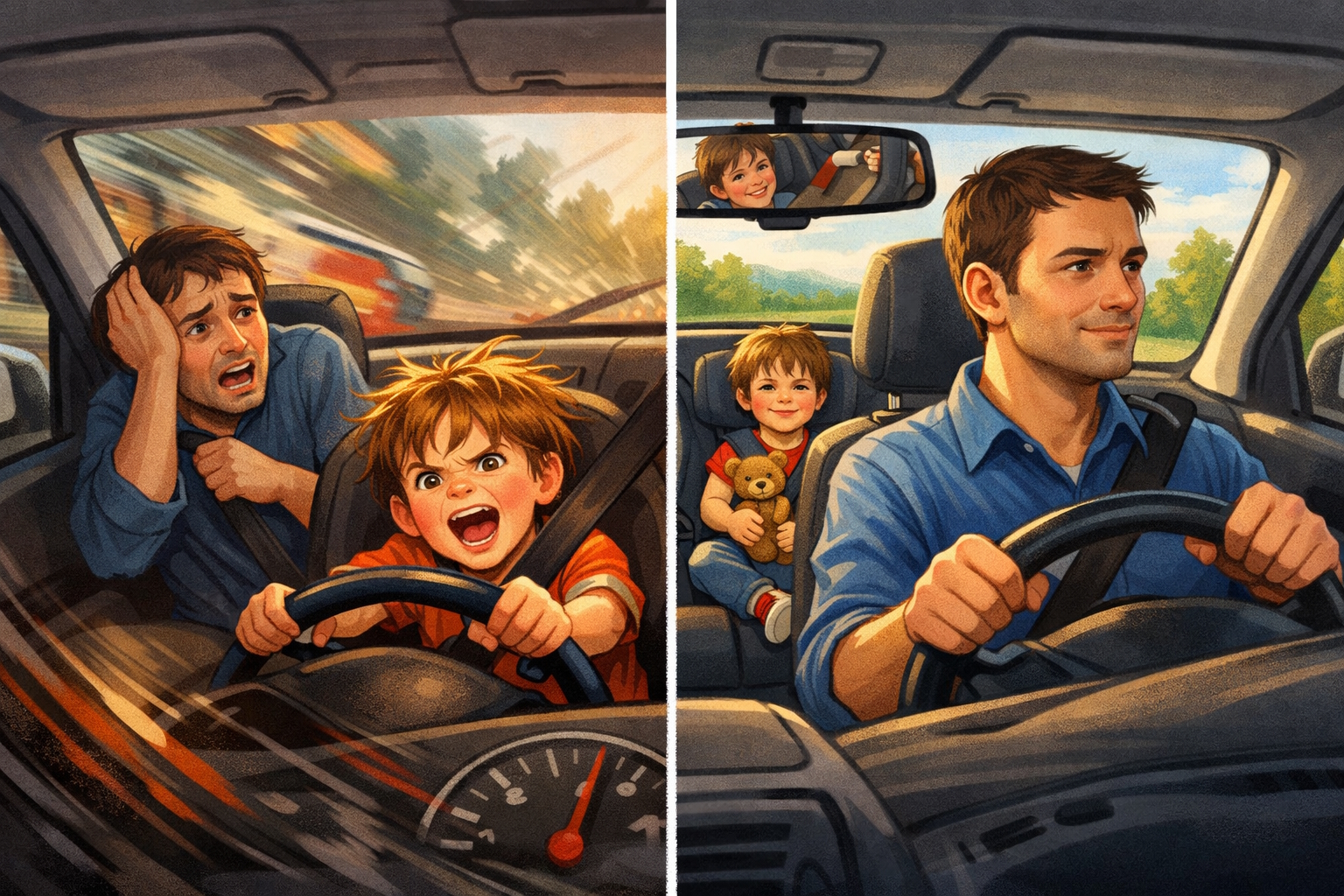
There is an image that may help those who struggle with their emotions to understand what is happening within them. Picture a motor vehicle, the kind that carries a person through the ordinary terrain of daily life. Inside that vehicle sit two passengers: a responsible adult and a six-year-old child. The adult represents the reasoning, reflecting, governing part of the mind. The child represents the emotional, reactive, instinctive part. Both belong in the vehicle. Both are necessary for the journey. But the question that shapes everything is simple: who is driving?
When a person loses control of their emotions, when anger flares or fear overwhelms or distress consumes, the child has taken the wheel. The adult sits helpless in the back seat, watching as the vehicle swerves and accelerates, unable to intervene. The child cannot drive well. The child reacts to every threat, every frustration, every surge of feeling with immediacy and intensity. Damage is done. Relationships are harmed. Words are spoken that cannot be retrieved. And when the moment passes, the adult is left to survey what has happened, often with regret, sometimes with shame.
Scripture speaks into this experience with directness. The book of Proverbs compares a person who lacks self-control to a city with broken walls, undefended and exposed. In the ancient world, walls were not ornamental. They were survival. A city without them was open to invasion, vulnerable to any force that chose to enter. So too the person who cannot govern their inner life. They are at the mercy of whatever emotion rises, whatever impulse presents itself. They have no defence.
Modern neuroscience, though it speaks in different language, describes remarkably similar dynamics. The amygdala, a small almond-shaped structure deep in the brain, processes threat and emotion with extraordinary speed. It activates before the pre-frontal cortex, the seat of reasoning and executive function, can fully engage. Daniel Goleman named this phenomenon amygdala hijack: the emotional brain overwhelming the rational brain, bypassing slower, more considered thought. What theology calls the flesh overriding the spirit, neuroscience observes as subcortical structures overriding cortical control. The vocabulary differs. The reality is the same.
Yet the image of the vehicle has a second configuration, one that represents health rather than dysfunction. In this version, the adult is behind the wheel. The child remains in the vehicle, seated in the back, still present, still feeling, still reacting. But the adult drives. The adult looks into the mirror, sees what the child is experiencing, and acknowledges it without being controlled by it. This is not the absence of emotion. It is the governance of emotion. The adult can say, calmly and truthfully, I am angry right now, without screaming, without lashing out, without letting the anger dictate the next action. The emotion is real. It is recognised. But it does not steer.
This is what Scripture means by self-control. The Greek word used in Paul’s list of the fruit of the Spirit is egkrateia, which carries the sense of possessing power, of holding in hand the passions and desires. It is not the elimination of feeling but the mastery of it. And crucially, it is listed among the fruit of the Spirit, not the achievements of the self. This distinction matters profoundly. Self-control, in Christian understanding, is not a product of human willpower. It is a gift cultivated through abiding in Christ, made possible by the indwelling presence of the Spirit. The person who white-knuckles their emotions into submission, relying on sheer discipline, is not displaying the fruit of the Spirit. They are displaying the flesh’s imitation of it.
This is where the third configuration of the image becomes important. In some cases, the adult is behind the wheel, but rather than acknowledging the child, they refuse to look in the mirror at all. They want to pull the vehicle over, open the door, and leave the child on the side of the road. They have been taught, often by parents or cultures that feared emotion, to not feel. To be strong. To suppress.
But this is not wholeness. This is amputation. The person who denies their emotions does not become more rational; they become less human. They cut off a part of themselves that God designed, that bears the image of their Creator. Scripture never presents a God who is emotionally vacant. The God of the Bible grieves, rejoices, loves, and is moved to anger. Jesus, in the Garden of Gethsemane, was besieged by sorrow and distress so intense that He sweat drops like blood. He did not suppress what He felt. He brought it to the Father. He expressed it honestly. And then He submitted His will to God’s purposes. This is not the elimination of emotion but the offering of it.
There is a fourth configuration, perhaps the most deceptive of all. In this image, the adult is behind the wheel, but the vehicle has pulled to the side of the road and stopped. The child is screaming in the back seat, and the adult, unwilling either to drive forward or to address what the child is feeling, simply sits there. They do not move. They do not speak. They absorb the noise, hoping it will pass, telling themselves they are being patient when in fact they are being paralysed. This is not governance. This is endurance without resolution, bottling without release. The emotions are not expressed. They are not processed. They accumulate.
What happens next is predictable. The child, having been neither heard nor governed, eventually forces their way to the front. The explosion comes, and when it comes, it comes with interest. All the stored frustration, all the swallowed anger, all the unspoken hurt pours out at once, often onto someone who does not deserve it. Perhaps it is someone who happened to say the wrong thing at the wrong moment, a colleague or friend who becomes the unwitting target of weeks or months of accumulated feeling. In the analogy, it might be a police officer who stops to check whether the occupants of the stationary vehicle are alright, only to be met with fury they did not provoke. Or perhaps the explosion lands on the person perceived to be the original offender, but now loaded with grievances from the past that have nothing to do with the present moment. The response is disproportionate because it carries the weight of everything that was never addressed. Either way, the damage is done. And the adult, having thought they were exercising restraint, discovers that what they called patience was only delay, and what they called strength was only suppression wearing a different mask.
Research confirms what experience teaches: suppression does not work. Studies consistently show that attempting to inhibit emotional expression fails to reduce the internal experience of emotion. Worse, it impairs memory, increases physiological stress, and predicts higher rates of depression and anxiety. The person who refuses to feel does not heal. They store. And what is stored eventually demands attention, often in ways far more destructive than honest acknowledgement would have been.
The healthy alternative is what researchers call cognitive reappraisal and what Scripture models as lament. David, in the Psalms, does not hide his anguish. He cries out to God with frustration, fear, and grief. He does not soften his language or pretend strength he does not feel. But neither does he remain in despair. The laments almost always turn toward trust, toward worship, toward the God who hears. David feels fully and then reorients. He does not let his emotions have the final word, but he does not pretend they do not exist.
Modern neuroscience has demonstrated that simply naming an emotion reduces its intensity. When a person says I am angry rather than acting out the anger, activity in the amygdala decreases while activity in the pre-frontal cortex increases. The act of verbalising, of putting words to feeling, engages the reasoning brain and quiets the reactive one. This is not suppression. It is recognition. It is the adult in the vehicle looking into the mirror, seeing the child, and saying, I see you. I know what you are feeling. But I am driving.
For Christians, this has a deeper dimension still. Paul writes to the Galatians that the flesh and the Spirit are in opposition, each desiring what is contrary to the other. This is not merely a psychological observation. It is a spiritual reality. When a person yields control to unchecked emotion, they are not simply experiencing a neurological event. They are, in some sense, yielding the wheel to something other than the Spirit. At best, this is the flesh asserting itself, the old nature demanding its way. At worst, it is an opening for the enemy, a foothold given where none should be granted. Ephesians warns against letting anger linger precisely because unresolved rage gives opportunity to the devil. What we yield to shapes what speaks through us.
This does not mean that every outburst is demonic. But it does mean that the question of who is driving is not merely psychological. It is spiritual. The person who habitually surrenders to their emotions, who lets the child take the wheel again and again, is forming themselves in a direction away from the Spirit’s fruit. The person who denies their emotions entirely, who refuses to let the child exist, is also moving away from wholeness, away from the full humanity God designed. The path forward is neither indulgence nor suppression. It is governance.
And governance, true governance, is not something the self can finally accomplish alone. This is why self-control is a fruit of the Spirit and not a technique to be mastered. The Christian who desires to govern their emotions well must seek this capacity from God. They must abide in Christ, walk by the Spirit, and trust that what they cannot produce in themselves can be cultivated by grace. This is not passivity. It requires intention, practice, and honesty. But it is not self-reliance either. It is dependence.
The Apostle Paul, writing to the Romans, urges believers not to let sin reign in their mortal bodies but to offer themselves to God as instruments of righteousness. The image is one of yielding, of presenting the self to a master. The question is never whether the self will be governed. It always is. The question is by whom. The Christian who offers their emotional life to God, who invites the Spirit into the places of anger and fear and grief, finds that governance becomes possible in ways it never was before. Not because the emotions disappear, but because they are met, acknowledged, and ordered toward love.
The vehicle continues on its journey. The adult remains at the wheel. The child is not abandoned but held. Emotion is not erased but expressed rightly, in ways that build rather than destroy, that speak truth rather than wound, that reflect the character of Christ rather than the chaos of the flesh. This is the fruit of the Spirit at work. This is what it means to be whole.