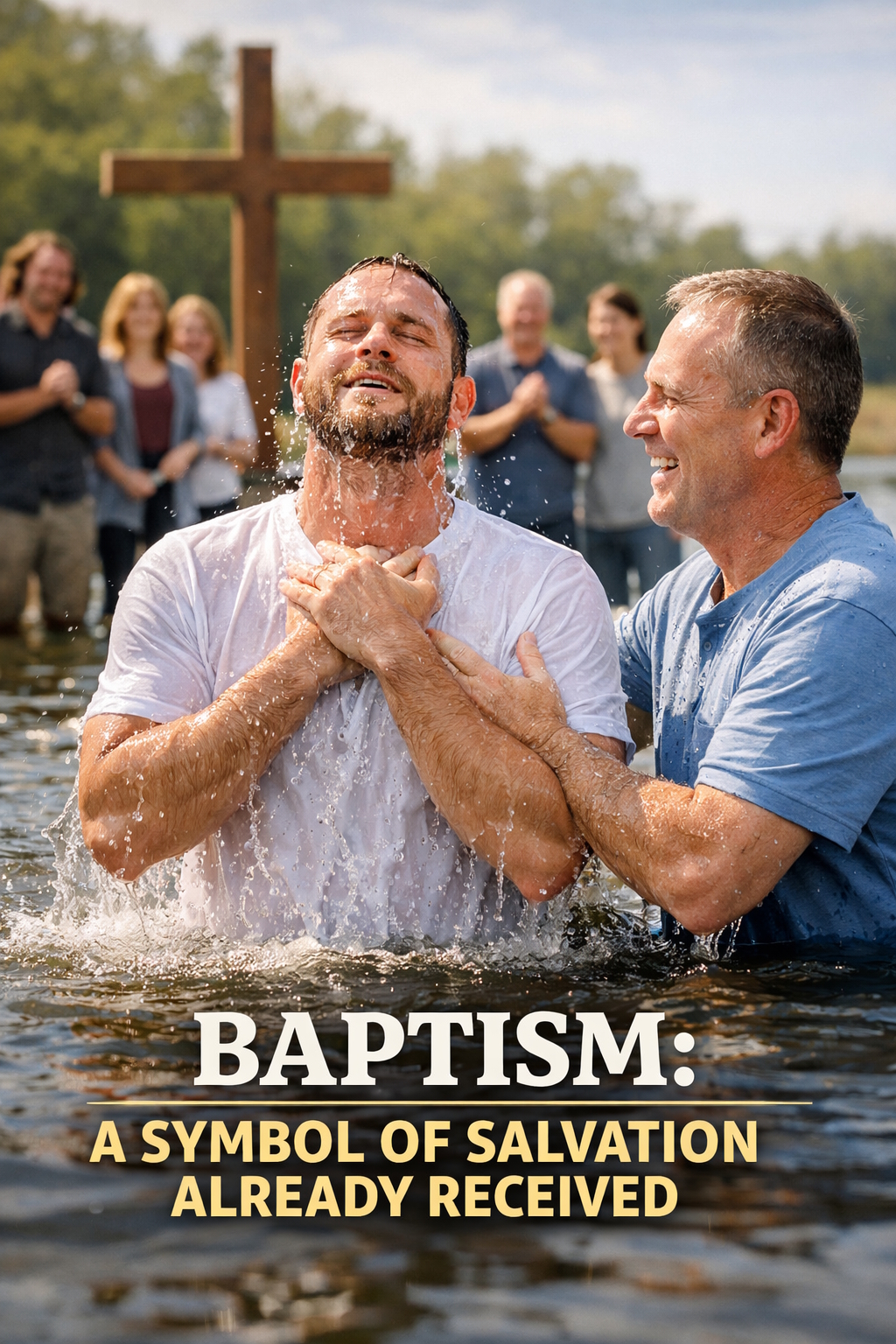
Among the questions that divide sincere Christians, few are as persistent as the meaning of baptism. For some, it is the moment salvation is conferred, the act through which grace is applied. For others, it is a public declaration of a salvation already received, an act of obedience rather than a means of regeneration. Both positions are held by believers who love Christ and honour Scripture. Both deserve careful examination rather than dismissal.
The question matters because it touches on the heart of the gospel itself. If salvation is by grace through faith, as Paul declares in Ephesians, then the role of baptism must be understood in relation to that foundation. If baptism is required for salvation, then faith alone is not sufficient. If baptism is a response to salvation, then its importance lies elsewhere. Scripture must guide the answer, and Scripture speaks more clearly on this matter than the ongoing debate might suggest.
The most frequently cited passage in favour of baptismal regeneration is Acts 2:38, where Peter tells the crowd at Pentecost to repent and be baptised for the forgiveness of sins. Read in isolation, this appears to make baptism essential. But the Greek preposition translated for can also mean because of or in view of, as it does in Matthew 12:41, where the people of Nineveh repented because of the preaching of Jonah. Peter’s instruction may be calling for baptism as a response to forgiveness already granted through repentance and faith, not as its cause. The grammar of the sentence supports this reading: the verb repent is in the second person plural, while be baptised is in the third person singular, suggesting a distinction in how each relates to forgiveness.
More decisively, the narrative of Acts itself undermines the idea that baptism is the mechanism of salvation. In Acts 10, Cornelius and his household receive the Holy Spirit before they are baptised. The Jewish believers with Peter are astonished that the gift of the Spirit has been poured out on Gentiles. Peter then orders them to be baptised, but the order is critical: the Spirit came first. If the Spirit’s indwelling is the mark of salvation, and if Cornelius received it before baptism, then baptism did not cause his salvation. It followed it.
The thief on the cross offers another witness. In Luke 23, a man who has lived in rebellion turns to Jesus in his final hours and hears the words, Today you will be with me in paradise. He dies without baptism, without church membership, without any outward act of obedience except faith expressed in a moment of desperation. If baptism were essential for salvation, this promise would be inexplicable. Some argue that the thief lived under the old covenant and was therefore exempt, but this reasoning undermines itself. If Jesus could save by faith alone under extraordinary circumstances, the principle is established. Salvation has always rested on faith in God’s provision, not on ritual completion.
Paul’s own testimony reinforces this. Writing to the Corinthians, he states that Christ did not send him to baptise but to preach the gospel. He thanks God that he baptised only a few, lest anyone say they were baptised in his name. This is a striking statement. If baptism were the means of salvation, Paul’s words would be incomprehensible. He would be saying that Christ did not send him to save people. But Paul clearly sees the gospel, not baptism, as the saving message. Baptism matters, but it is not the gospel itself.
The passage most often used to argue that baptism saves is 1 Peter 3:21, where Peter writes that baptism now saves you. Yet Peter immediately clarifies: not as a removal of dirt from the body, but as an appeal to God for a good conscience, through the resurrection of Jesus Christ. Peter is not attributing saving power to the water. He is describing baptism as the occasion for an inward appeal to God, a conscious act of faith that petitions God for cleansing. The saving reality is the faith expressed, not the physical act performed. Wayne Grudem paraphrases it helpfully: baptism now saves you, not the outward physical ceremony but the inward spiritual reality which baptism represents.
John 3:5 requires similar care. Jesus tells Nicodemus that no one can enter the kingdom of God unless they are born of water and the Spirit. Some read this as a reference to baptism, but several considerations weigh against that interpretation. First, Christian baptism did not yet exist when Jesus spoke these words. Jesus rebukes Nicodemus for not understanding, but how could Nicodemus understand a practice that had not been instituted? Second, the phrase water and Spirit echoes Ezekiel 36:25-27, where God promises to sprinkle clean water on His people and put His Spirit within them. The language is covenantal and prophetic, describing the cleansing and transforming work of the Spirit, not a ritual to be performed. D. A. Carson argues that only one birth is in view, a spiritual rebirth involving cleansing and renewal, and that water and Spirit together describe that single reality. Linda Belleville reaches a similar conclusion, understanding born of water and Spirit as a unified metaphor for spiritual transformation rather than a sequence of physical and spiritual acts.
The broader witness of the New Testament supports this reading. Salvation is consistently tied to faith in Christ, repentance, and the receiving of the Spirit. Baptism follows as a public declaration, an act of identification with Christ’s death and resurrection, an entry into the visible community of believers. Romans 6 describes baptism as a symbolic union with Christ in His burial and rising, not as the cause of that union but as its outward expression. The believer who goes under the water pictures death to the old life. The believer who rises from the water pictures resurrection to new life. The symbol is powerful precisely because the reality it represents has already occurred.
None of this diminishes baptism. Jesus commanded it. The apostles practised it immediately upon conversion. It marks the boundary between private belief and public confession, between individual faith and corporate belonging. To neglect baptism is to disobey Christ. But disobedience and damnation are not the same. A person who believes but has not yet been baptised is not outside salvation. A person on their deathbed who turns to Christ in faith is not excluded from paradise because water was unavailable. The thief on the cross stands as an enduring testimony that God is not bound by ritual.
This distinction matters pastorally. When baptism is treated as essential to salvation, believers who have not been baptised live under unnecessary fear. When baptism is treated as optional or irrelevant, believers miss the richness of what Christ has commanded. The biblical balance is clear: baptism is an act of obedience that testifies to a salvation already received, not a work that earns or secures it. It is the first step of discipleship, not the last requirement for acceptance.
The early church baptised new believers promptly, often on the same day they professed faith. The Ethiopian official, the Philippian jailer, the converts at Pentecost all entered the waters without delay. This urgency reflected not a fear that salvation hung in the balance, but a joy that demanded expression. Baptism was the natural response to grace received, the public seal of a private transformation.
For those who hold baptism to be salvific, charity requires that we recognise their sincerity and their reliance on Scripture as they understand it. The church has debated this question for centuries, and faithful believers stand on both sides. But the weight of biblical evidence points toward a consistent pattern: faith saves, and baptism follows. The Spirit comes to those who believe, and baptism identifies them with the community of the redeemed. The water does not wash away sin. The blood of Christ does. Baptism announces what grace has already accomplished.
The command remains. Every believer should be baptised, not to secure salvation, but to honour the Lord who secured it for them. In the waters of baptism, the believer declares before heaven and earth that they belong to Christ, that they have died to the old life, and that they have been raised to walk in newness of life. That declaration is no small thing. It is the fitting response of a grateful heart to the God who saves by grace alone, through faith alone, in Christ alone.